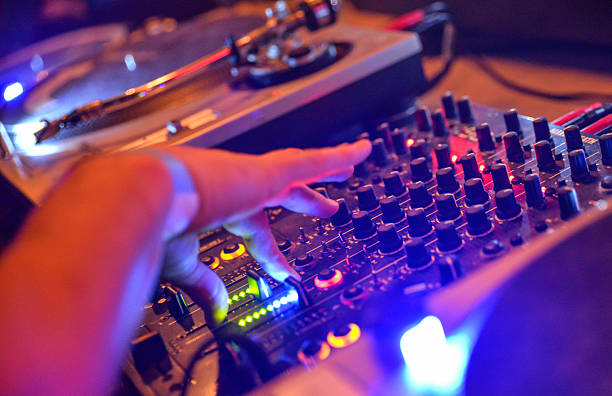


So you’ve got your tracks locked in, your beatmatching is butter, and you’re starting to wonder what’s really going on inside your mixer when all those signals get crunched into one stereo output. That’s where summing comes in. It’s the unsung hero of the mix, the moment your kick, your synth, your vocal, and your hats all decide to hold hands and become one cohesive wave of sound. In the DJ world, you’ve got two flavors: analog summing and digital summing. And if you’re diving into the pro-level mixer universe, you need to know which one vibes with your ears, your workflow, and your budget.
First off, let’s be real: analog summing is the old-school soul food. It’s what Larry Levan was cooking with at the Paradise Garage, what Frankie Knuckles leaned on in the Warehouse. When you sum signals in the analog domain, you’re using actual circuits, resistors, and transistors to physically combine voltages. There’s no binary translation happening, no rounding errors. The result? A warmth, a slight harmonic saturation, and a glue that feels like the mix is breathing. That’s why some DJs swear by vintage analog mixers like the Boz, the Rane MP2015, or even the cult-favorite Urei 1620. They give you that three-dimensional depth where every element sits in its own pocket but still cuddles up to the others. If you’re playing deep house, disco, or classic techno, analog summing can make your set feel like a live organism, not a sterile playlist.
But here’s the catch: analog summing is expensive, heavy, and finicky. Those transformers and discrete op-amps degrade over time, and if you’re touring from Berlin to Ibiza to Bangkok, you’re hauling a lot of weight. Also, the summing buses on analog mixers can add noise, especially if you chain too many channels. It’s a trade-off. You get magic, but you also get maintenance.
Now enter digital summing. This is the realm of modern pioneers like Wendy Hunt, who pushed the boundaries of laptop-based sets and hybrid controllers. Digital summing happens inside a computer or a digital mixer like the Pioneer DJM-V10 or the Allen & Heath Xone:96 in digital mode. The math is precise, repeatable, and perfectly silent. No hiss, no noise floor creeping in, no channel bleed. Every summing algorithm is sample-accurate, so your transients stay punchy and your stereo image can be razor-sharp. If you’re mixing drum and bass, modern hip-hop, or any genre that demands pristine clarity and sub-bass that doesn’t wobble, digital summing is your best friend. It gives you the cleanest platform to stack layers without mud.
But the downside? Digital summation can sound flat or brittle if the converters aren’t top-tier. Some DJs say it lacks that “analog glue,” that slight compression and harmonic distortion that makes a mix feel like a single performance rather than a composite of tracks. There’s a reason why many digital mixers now include analog-style saturation circuits or emulation modes. People miss the vibe.
So what do you actually need for your pro-level mixer rig? It depends on your vibe and your gigs. If you’re a traveling DJ hitting bucket-list clubs like Berghain, Fabric, or Warung Beach, you’re likely using whatever club-standard mixer is bolted to the booth. Most of those are digital or hybrid these days. But for your home studio or your curated sets where you want to imprint your signature sound, an analog summing setup can be a secret weapon. You don’t have to go full vintage. Look at mixers like the Toft ATB, the Daking FET II, or even a passive summing box like the Radial SumMix. Pair it with a solid audio interface, and you’ve got analog warmth without the motherboard headaches.
Bottom line: neither is “better.” They’re two different textures in your sonic palette. Digital summing gives you surgical precision. Analog summing gives you soul. The best DJs, from Frankie to modern heavyweights, use both depending on the moment. Gear up with intention, not hype. Your ears—and your dancers—will thank you.